

Well, I have to say that the last 12 hours of my graduate school career were pretty darn stressful. I tried troubleshooting for hours, but was unable to get either Jing or Audacity to work in order to make a screencast or a podcast of my final presentation.
I finally realized I wasn't going to be able to get either to work and started thinking about an alternative method of presentation. So, rather than screencasting my presentation, I ended up doing it via Voicethread.
Here are the other elements of my project:
Staff Wiki
Staff Blog
Staff Ning
They say you usually learn more from your failures than your successes, and the experience I had with trying to get my presentation recorded last night and today really showed me how true that is! I want to thank Steve again publicly for introducing us to so many different technologies and applications this semester. We all now have so many different tools in our social software "bag of tricks" and never know when we might need to use one of them.
I really enjoyed working with all of you this semester too and hope everyone enjoys the much deserved time off!
Showing posts with label scils598. Show all posts
Showing posts with label scils598. Show all posts
Thursday, December 18, 2008

Friday, December 12, 2008
Social Software Class
I also want to thank Steve for having developed this class for SCILS. I feel that the knowledge and experience I gained from it will be invaluable to me in my career and think all the material covered was important. I also think the order of the topics presented flowed nicely.
If anything could be added, I would have liked to have learned a little more about/gotten to use Skype. (I know now we at least know about it, but I like having my hand held when trying new things.)
I also think that while using the different applications (like Twitter and Blogger) each week for our posts was important in helping us develop familiarity with them, I don't think class discussions ever got as deep and involved as they did in the other online courses I've taken which used the threaded discussions in eCollege. I'm not suggesting adding eCollege discussions to each week's class assignments (that would just push the workload way over the edge!) I'm just pointing out the observation of my experience. In past courses, I was always sure to read what everyone had written already before I posted anything (just as one would hear everything that was said in order in a F2F class), but I found myself usually posting my own blog entries here before reading everyone else's. I think the threaded discussions in eCollege also encourage people to comment more on their classmates' comments and explore different topics and tangents each week. I missed many of the comments people had made on my comments (until I realized I should check the "email notification" option in blogger's comment section...but, even then, I didn't always check my class-made emails on a very regular basis, so still became aware of new comments sometimes weeks afterwards.) While GoogleReader and Bloglines made it very convenient to read everyone's blog posts each week, their not showing comments made to each post was a major drawback. (I initially tried clicking on everyone's blog post to read the comments made to it, but that ended up becoming very time consuming.) I'm sure aggregators will improve over time and perhaps, this will one day be a feature they will have. If this were the case, blogging each week would be more like like a real "class discussion" and less like individual weekly presentations.
But, overall, I really loved the class and enjoyed "meeting" and working with everyone. I love the idea of meeting up again virtually somewhere too after the semester.
If anything could be added, I would have liked to have learned a little more about/gotten to use Skype. (I know now we at least know about it, but I like having my hand held when trying new things.)
I also think that while using the different applications (like Twitter and Blogger) each week for our posts was important in helping us develop familiarity with them, I don't think class discussions ever got as deep and involved as they did in the other online courses I've taken which used the threaded discussions in eCollege. I'm not suggesting adding eCollege discussions to each week's class assignments (that would just push the workload way over the edge!) I'm just pointing out the observation of my experience. In past courses, I was always sure to read what everyone had written already before I posted anything (just as one would hear everything that was said in order in a F2F class), but I found myself usually posting my own blog entries here before reading everyone else's. I think the threaded discussions in eCollege also encourage people to comment more on their classmates' comments and explore different topics and tangents each week. I missed many of the comments people had made on my comments (until I realized I should check the "email notification" option in blogger's comment section...but, even then, I didn't always check my class-made emails on a very regular basis, so still became aware of new comments sometimes weeks afterwards.) While GoogleReader and Bloglines made it very convenient to read everyone's blog posts each week, their not showing comments made to each post was a major drawback. (I initially tried clicking on everyone's blog post to read the comments made to it, but that ended up becoming very time consuming.) I'm sure aggregators will improve over time and perhaps, this will one day be a feature they will have. If this were the case, blogging each week would be more like like a real "class discussion" and less like individual weekly presentations.
But, overall, I really loved the class and enjoyed "meeting" and working with everyone. I love the idea of meeting up again virtually somewhere too after the semester.
Alcohol, sugar and caffeine aren't all that good for us either, but still serve a purpose in our lives
What's "bad" and what's "good" are really subjective and personal designations. I think librarians have traditionally always refrained from passing judgement on different works and allowing their own personal opinions influence the titles they acquire and recommend. Johnson's book reminds us how we have to extend this position beyond books now and to other forms of media and information. Whether or not we think a particular movie, show, game, etc., is "bad" or "good", each has some inherent value (and Johnson makes the strongest case I have ever heard/read as to how worthwhile and complex that value actually is.) I once had a customer come up to me in the library and ask me to make a young girl get off a library computer because she was "only" playing a video game on it while she herself had "real work" to do. I told her I couldn't do that using the old "equal access" policy, but a part of me wishes I could relive the scene and throw a line about how video games contribute to people's cognitive development into my denial of her request.
Libraries are already including DVD's and video games in their collections and I'm sure this is a trend that will continue and expand. Understanding the value of different types of media will aid librarians in their collection development decisions.
As far as educators go, I think they should be more aware of the educational value of movies, tv shows and games. (Someone earlier blogged about making them read Johnson's book, which I totally agree with.) My 5th grade son told me their school librarian made a statement to them that computers should be used for research and not video games (and also proudly added as an aside that she never played a video game in her life. I was astounded, and asked him how old she was. He answered, "Older than you," which, in his mind, is REALLY old!) Dismissing any of the media our children use and enjoy without understanding it is very counterproductive and widens the gap between us. I was never a huge video game player myself (things got a little too complicated for me after the Atari system) but these past two weeks' class materials and Johnson's book really helped open my mind to their inherent value. Educators must realize this too, and should work on making learning scenarios more engaging for students, the way games are.
Libraries are already including DVD's and video games in their collections and I'm sure this is a trend that will continue and expand. Understanding the value of different types of media will aid librarians in their collection development decisions.
As far as educators go, I think they should be more aware of the educational value of movies, tv shows and games. (Someone earlier blogged about making them read Johnson's book, which I totally agree with.) My 5th grade son told me their school librarian made a statement to them that computers should be used for research and not video games (and also proudly added as an aside that she never played a video game in her life. I was astounded, and asked him how old she was. He answered, "Older than you," which, in his mind, is REALLY old!) Dismissing any of the media our children use and enjoy without understanding it is very counterproductive and widens the gap between us. I was never a huge video game player myself (things got a little too complicated for me after the Atari system) but these past two weeks' class materials and Johnson's book really helped open my mind to their inherent value. Educators must realize this too, and should work on making learning scenarios more engaging for students, the way games are.
Thursday, December 11, 2008
Jenesea Swansong hated Second Life until she discovered ALA Island!
Gabrielle made the comment that perhaps "the third time's the charm" and that was also my experience in exploring Second Life this week. The first couple of times I went there, I felt like Alice right after falling down the rabbit hole: lost, confused and wondering what everyone I met was smoking. I wonder if it had anything to do with my "visiting" at night? (Maybe that's when all the loonies come out?) Like Amy mentioned too, I felt kind of silly in my little pink polka dot dress amidst all the leather, animal parts and other get-ups the people I encountered were in. My "home" was set in Wengen in a ski lodge (I thought I had chosen to visit and set my "home" there, but after reading GC's post, I wonder if that's a default?) I played some kind of game there with everyone (where we grabbed these things that were falling out of the sky for money, but I don't think I did very well, since my bank account is still empty!) I also got myself teleported to Information Island and walked around a bit, but didn't see much to do and was too shy to walk up and talk to anyone.
The next night, I went to a "library" that seemed to be somewhere in Asia (I couldn't read any of the signs.) Seeing that I could visit different countries, I tried to go to Italy but was denied access. I then, after noticing it advertised somewhere, went to Candy Cane Lane (which I found out once I was there was in Hong Kong Island.) It was pretty, but a little spooky because it was empty. So, I tried to go back "home" again thinking it might be better than the night before, but it was still one big freak-show. So I teleported myself back to Info Island and sat on someone's chair (hoping he wouldn't mind) before logging off.
Today, however, I found ALA Island and had a much better in-world experience! I didn't meet anyone there, but upon entering, was greeted with a welcome message and found helpful signs and explanations everywhere I went. It is very well organized (every round table and sub-organization has its own little "information booth") and there are directional signs and different events at every turn. (It's definitely a "place" created by librarians!)
I found a big, comfy couch to chill out on and was able to make a READ poster of my Avatar reading the free book I acquired there (step by step directions on how to do this are right there if anyone else wants to check it out/try it.)
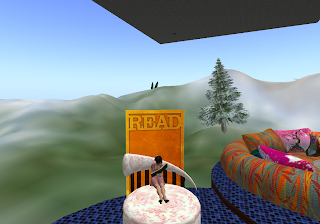
So, while Second Life isn't as intriguing a place as I had originally expected it to be, ALA Island helped me see the potential it has.
The next night, I went to a "library" that seemed to be somewhere in Asia (I couldn't read any of the signs.) Seeing that I could visit different countries, I tried to go to Italy but was denied access. I then, after noticing it advertised somewhere, went to Candy Cane Lane (which I found out once I was there was in Hong Kong Island.) It was pretty, but a little spooky because it was empty. So, I tried to go back "home" again thinking it might be better than the night before, but it was still one big freak-show. So I teleported myself back to Info Island and sat on someone's chair (hoping he wouldn't mind) before logging off.
Today, however, I found ALA Island and had a much better in-world experience! I didn't meet anyone there, but upon entering, was greeted with a welcome message and found helpful signs and explanations everywhere I went. It is very well organized (every round table and sub-organization has its own little "information booth") and there are directional signs and different events at every turn. (It's definitely a "place" created by librarians!)
I found a big, comfy couch to chill out on and was able to make a READ poster of my Avatar reading the free book I acquired there (step by step directions on how to do this are right there if anyone else wants to check it out/try it.)

So, while Second Life isn't as intriguing a place as I had originally expected it to be, ALA Island helped me see the potential it has.
Saturday, December 6, 2008
Anyone up for a quick game of Scrabble?
Talk about pressure (trying to play a game like Scrabble while videoing/talking about it!)!
Here is a brief look at playing Scrabble online through pogo.com

Friday, December 5, 2008
Screencasting advice
This is a bit difficult for me to write about screencasting "best practices" as I feel that I'm still trying to get comfortable with the whole practice myself. (I still find that it's much harder than it looks!) To someone just starting out, I would remind them of that fact. I would also encourage them to really research and make sure they invest in the best microphone/headset that they can. (I've been having a lot of trouble with mine over the past few weeks.)
I would also recommend writing out an outline and practicing the presentation at least a couple of times. (I found the more I had to re-record because of mistakes and technical difficulties, the more natural sounding I became.)
I would recommend not allowing your kids or spouse to be on the same floor where you are recording because they'll either a)make too much noise, b)inadvertently walk in and say something that will mess your whole recording up, or c) eavesdrop and then later make fun of you.
I'd also say that less is definitely more (and shorter is better for the most part.) Refraining from cursing, no matter how frustrated and aggravated you might get, is also a good habit to adopt because, in a pinch, a screencast with a couple minor mistakes might work, but one where you totally lost it won't.
I would also recommend writing out an outline and practicing the presentation at least a couple of times. (I found the more I had to re-record because of mistakes and technical difficulties, the more natural sounding I became.)
I would recommend not allowing your kids or spouse to be on the same floor where you are recording because they'll either a)make too much noise, b)inadvertently walk in and say something that will mess your whole recording up, or c) eavesdrop and then later make fun of you.
I'd also say that less is definitely more (and shorter is better for the most part.) Refraining from cursing, no matter how frustrated and aggravated you might get, is also a good habit to adopt because, in a pinch, a screencast with a couple minor mistakes might work, but one where you totally lost it won't.
Which game console to get?
If I were in charge of selecting a game system for our library, I would start my research by seeing what other libraries similar to ours are using and would ask their librarians why they selected the system they did, how are they using the system, what's the response from their customers and would they have chosen something different if they could make their purchase decision over again. I would also consult various library blogs to get a feel for which system generally seems to work best (and would consider contacting those blogging librarians who are expert "gamers" if I had specific questions.) Most importantly, I would ask our customers themselves if they would come to library sponsored gaming events and, if so, which game console would THEY prefer?
As far as criteria to consider after doing this background research, I would primarily focus on which system would get the most use (among all patrons, which would include children through senior citizens in a public library setting.) Secondly, I would (be forced to) consider cost.
Based on these things, I would currently choose the Wii system. Based upon what I've read and heard from other librarians: the PS3 is currently too expensive (for both the system and the games; the PS2 is more affordable (but probably lacks the "wow" factor the wii and xbox360 have); and, the xbox360, while affordable, good for multi-playing games and great graphics, is more limited in game selection for children and many senior citizens. The Wii seems to have that Goldilockish-"just right"-fit for public libraries trying to acquire a system that will appeal to most of its customers.
As new games and gaming systems are continually being developed (and things like price, selection and users' wants and needs change,) librarians will constantly have to reassess their gaming offerings.
As far as criteria to consider after doing this background research, I would primarily focus on which system would get the most use (among all patrons, which would include children through senior citizens in a public library setting.) Secondly, I would (be forced to) consider cost.
Based on these things, I would currently choose the Wii system. Based upon what I've read and heard from other librarians: the PS3 is currently too expensive (for both the system and the games; the PS2 is more affordable (but probably lacks the "wow" factor the wii and xbox360 have); and, the xbox360, while affordable, good for multi-playing games and great graphics, is more limited in game selection for children and many senior citizens. The Wii seems to have that Goldilockish-"just right"-fit for public libraries trying to acquire a system that will appeal to most of its customers.
As new games and gaming systems are continually being developed (and things like price, selection and users' wants and needs change,) librarians will constantly have to reassess their gaming offerings.
Are we smarter than a fifth grader?
I once read that the particular way animals play when they are young helps them develop the skills they’ll need to survive and function as adults. (For example, lion cubs like to wrestle and drag things around which helps them develop the skills they’ll need to be effective hunters, and much of human children’s play involves emulating things adults as they develop cognitive, socio-emotive, motor and other necessary skills.) Steven Johnson’s book reminded me again about the importance of play, not just for children, but for us all. As our world becomes more complex, all types of entertainment seem to follow suit. I think Johnson’s book (at least from what I’ve read so far-Part I) shows that he clearly disagrees with George Will’s statement about pop culture being a “more sophisticated delivery of stupidity.”
While I personally feel that reading a book is “better” than watching a movie or playing a video game, media definitely plays an ever-increasingly important role in our society. We’ve all seen how the definition of “literacy” has evolved recently. I’m reminded of the Wesch videos we watched earlier this semester and the idea of how scanning hundreds of web pages for information is essentially a form of “reading” today. (And I’m sure teens who play fast-paced, hi-tech video games are much more skilled at this than I!) I think Johnson’s explanation of how media has evolved and the cognitive effects this has had on us all was very interesting and pretty convincing.
While I personally feel that reading a book is “better” than watching a movie or playing a video game, media definitely plays an ever-increasingly important role in our society. We’ve all seen how the definition of “literacy” has evolved recently. I’m reminded of the Wesch videos we watched earlier this semester and the idea of how scanning hundreds of web pages for information is essentially a form of “reading” today. (And I’m sure teens who play fast-paced, hi-tech video games are much more skilled at this than I!) I think Johnson’s explanation of how media has evolved and the cognitive effects this has had on us all was very interesting and pretty convincing.
Monday, November 24, 2008
Ning's place in the online world
I think Nings have an important place in the "long tail" section of the online social networking arena. It's easy for someone to either find or create an online social network for any particular niche. (Here are just some examples.)
Personally, as one who is still a bit uncomfortable using sites like myspace and facebook, I feel that the option of creating a private networking site is one of the greatest advantages of Ning. The privacy and control features might be especially useful in a school setting where the use of any kind of social software tools is generally looked down upon. Even in a public library setting, I think many customers might feel more comfortable participating in a smaller, private online community, and they can be a great thing to use for book clubs, discussion groups and teen advisory boards.
But not all Nings are "small" and "private". Joyce Valenza's TeacherLibrarian Ning has over 2,000 members and anyone can register to join. Joining (or even just visiting) a ning such as this allows one to quickly connect with people who share common interests more efficiently, I think, than they could on the more "social" social networking sites.
Personally, as one who is still a bit uncomfortable using sites like myspace and facebook, I feel that the option of creating a private networking site is one of the greatest advantages of Ning. The privacy and control features might be especially useful in a school setting where the use of any kind of social software tools is generally looked down upon. Even in a public library setting, I think many customers might feel more comfortable participating in a smaller, private online community, and they can be a great thing to use for book clubs, discussion groups and teen advisory boards.
But not all Nings are "small" and "private". Joyce Valenza's TeacherLibrarian Ning has over 2,000 members and anyone can register to join. Joining (or even just visiting) a ning such as this allows one to quickly connect with people who share common interests more efficiently, I think, than they could on the more "social" social networking sites.
boyd on board
I really enjoyed reading Danah Boyd's account of the history of social networking sites. Reading about the rise (and, in some cases, fall) of different sites reminds us that, as with most social software applications, social networking sites are just a means to an end (and not an end in and of themselves.) A library can't set up a myspace or facebook account and then pat him/herself on the back and think, "There. I am now on the cutting edge of technology and am where my users are so we can connect online." Boyd's articles clearly show that all these applications will continue to evolve and that we need to keep abreast of the changes.
I also found her explanation about how the different sites appeal to different "class divisions" a bit troubling, but can clearly see the points she makes. (I also respect how she repeatedly admitted to being uncomfortable even broaching the topic.) Just as libraries have different collections and items that appeal to different users, it's essential that we are aware of the differences in social networking sites and can understand how each may appeal to different groups of people for different reasons.
I also found her explanation about how the different sites appeal to different "class divisions" a bit troubling, but can clearly see the points she makes. (I also respect how she repeatedly admitted to being uncomfortable even broaching the topic.) Just as libraries have different collections and items that appeal to different users, it's essential that we are aware of the differences in social networking sites and can understand how each may appeal to different groups of people for different reasons.
Sunday, November 23, 2008
"Sometimes you want to go where everybody knows your name..."
I was never really a diehard Cheers fan, but I think the whole concept behind its theme song, the fact that we all need a "place" to go "hang out" and connect with others, is the reason why social networking sites like Facebook and myspace are so "sticky".
Running into people we know and getting a chance to catch up with them is a very fulfilling experience. Sadly, our hectic, modern day lives don't usually allow this to happen enough in the "real" world on a regular basis (unless, of course, we're lucky enough to live by a corner pub or coffeehouse!) Social networking sites, though, allow us the opportunity to do this very easily and conveniently in the virtual, online world. I think this is why they have become immensely appealing and addictive to so many people over the past few years.
Running into people we know and getting a chance to catch up with them is a very fulfilling experience. Sadly, our hectic, modern day lives don't usually allow this to happen enough in the "real" world on a regular basis (unless, of course, we're lucky enough to live by a corner pub or coffeehouse!) Social networking sites, though, allow us the opportunity to do this very easily and conveniently in the virtual, online world. I think this is why they have become immensely appealing and addictive to so many people over the past few years.
How to make a profile badge in Facebook
Click here to learn how to make a profile badge in Facebook and insert it into your blog.
Saturday, November 15, 2008
Favorite Class Videos
Oh, this is so hard to pick "favorites" because I really enjoyed viewing everyone's videos the past couple of weeks!
To mention only a few,
I thought Jenna's "Do you want a treat?" was particularly hysterical.
Heather's "Strong Female Characters for Girls" was both informative and enjoyable to watch. (The Paper Bag Princess is one of my favorite picture books and I'm looking forward to checking out the other books too now!)
Renee's "How to make crabby patty cookies" was fun, and demonstrates how "seeing" something being made is much more effective and appealing than merely reading a recipe.
And Gabrielle's "Entertainment Video" was such a clever idea and shows how using the various effects in Windows Movie Maker can be utilized to easily (well, somewhat "easily") create interesting and professional looking videos.
But, again, I think everyone did such a great job. I also think using video can be a very effective and enjoyable educational tool for students in a school setting. (Though I doubt schools would condone the use of YouTube and blip.tv for hosting them.)
To mention only a few,
I thought Jenna's "Do you want a treat?" was particularly hysterical.
Heather's "Strong Female Characters for Girls" was both informative and enjoyable to watch. (The Paper Bag Princess is one of my favorite picture books and I'm looking forward to checking out the other books too now!)
Renee's "How to make crabby patty cookies" was fun, and demonstrates how "seeing" something being made is much more effective and appealing than merely reading a recipe.
And Gabrielle's "Entertainment Video" was such a clever idea and shows how using the various effects in Windows Movie Maker can be utilized to easily (well, somewhat "easily") create interesting and professional looking videos.
But, again, I think everyone did such a great job. I also think using video can be a very effective and enjoyable educational tool for students in a school setting. (Though I doubt schools would condone the use of YouTube and blip.tv for hosting them.)
Thursday, November 13, 2008
Can you recommend a good book?
When I first decided to become a librarian I used to envision myself skillfully helping people find the "perfect" next book to read. But I was shocked to discover how difficult providing readers' advisory services actually is, since the concept of what makes a "good book" is such an abstract, individual and personal thing. I've come to rely on resources such as Novelist to help with the task and feel that anyone who loves to read would enjoy using it too to explore the universe of books.
Because of this, my screencast is an introductory look on how to use the Novelist database:
http://www.screencast.com/t/36kqkOm5kj
I need to add that making a screencast was much harder than I ever imagined it could be. (Once again, Steve makes things look so easy and looks can be deceiving!) I apologize in advance for the quality/length of mine. My mouse is dying, I think, and kept "sticking" when I wanted to click and scroll on different parts of the screen. Can't tell you how many recordings I ditched prior to finally settling on this less-than-perfect final project. I can see how useful screencasts can be in the library world, but I also understand now that it takes a lot of time and effort to produce quality results.
Because of this, my screencast is an introductory look on how to use the Novelist database:
http://www.screencast.com/t/36kqkOm5kj
I need to add that making a screencast was much harder than I ever imagined it could be. (Once again, Steve makes things look so easy and looks can be deceiving!) I apologize in advance for the quality/length of mine. My mouse is dying, I think, and kept "sticking" when I wanted to click and scroll on different parts of the screen. Can't tell you how many recordings I ditched prior to finally settling on this less-than-perfect final project. I can see how useful screencasts can be in the library world, but I also understand now that it takes a lot of time and effort to produce quality results.
Friday, November 7, 2008
Educational vs. Entertainment Videos
This question about whether educational videos stand a chance against entertainment videos is kind of like asking whether vegetables can ever prevail over dessert. While one might be "better for you", both are necessary in their own way. And, depending on how they're "made" or "prepared", both can actually be enjoyable.
As Mary Madden's Pew Internet report clearly shows, watching videos online (both for entertainment and for educational purposes) is a growing trend. Producing and uploading videos is also increasing (especially with the younger, 18-29 year old generation.) I would love to see more schools embrace this vastly popular medium and use it more for educational purposes. Even more so than having students watch educational videos, producing their own can be a very effective learning experience. Also, as more people turn to the Web for their informational needs, I believe there will be a greater demand for better produced educational videos. For all the aforementioned reasons, I think educational videos will always have a place on the Web alongside the more fun & entertaining ones.
As Mary Madden's Pew Internet report clearly shows, watching videos online (both for entertainment and for educational purposes) is a growing trend. Producing and uploading videos is also increasing (especially with the younger, 18-29 year old generation.) I would love to see more schools embrace this vastly popular medium and use it more for educational purposes. Even more so than having students watch educational videos, producing their own can be a very effective learning experience. Also, as more people turn to the Web for their informational needs, I believe there will be a greater demand for better produced educational videos. For all the aforementioned reasons, I think educational videos will always have a place on the Web alongside the more fun & entertaining ones.
SCILS598f08 flickr pools
Looking at the tag clouds of both our "about us" pool: http://www.flickr.com/groups/scils598f08/pool/tags/
and our "ed-experience" pool:
http://www.flickr.com/groups/scils598f08-edexperience/pool/tags/
shows that (besides the obvious connection of this class!) we have many things in common. We all seem to have very crazy lives, but still are somehow able to make time to be with the people (and pets!) we care about and to do the things we enjoy. The different interests attest to the fact that one can no longer stereotype what a "typical librarian is like"!
I'd also like to add that I really enjoyed seeing what the scils mlis experience is like on-campus through the pictures those of you who take classes on campus shared.
and our "ed-experience" pool:
http://www.flickr.com/groups/scils598f08-edexperience/pool/tags/
shows that (besides the obvious connection of this class!) we have many things in common. We all seem to have very crazy lives, but still are somehow able to make time to be with the people (and pets!) we care about and to do the things we enjoy. The different interests attest to the fact that one can no longer stereotype what a "typical librarian is like"!
I'd also like to add that I really enjoyed seeing what the scils mlis experience is like on-campus through the pictures those of you who take classes on campus shared.
Disney in December
While Disney World can sometimes be a little chilly in December, it's a very festive time to visit. My entertainment video shows some scenes from our family's trip there a few years ago:
This can also be viewed in YouTube
This can also be viewed in YouTube
How to clean your house in a minute or less
Although I hate to clean, over the years I have perfected a quick method for getting it done. Step-by-step directions can be seen in my instructional video here:
You can also view this video on blip.tv
You can also view this video on blip.tv
Monday, November 3, 2008
Can we utilize the "long tail" of our collections?
The Anderson book initially started losing me this week as I felt it was getting deeper and deeper into economics. I, personally, hated taking economics in college (and hoped I'd find an industry to work in where I never had to deal with it.) The more of Anderson I read as the week progressed, however, the more I realized how economics really plays a huge role in libraries (as I know now, alas, it does in almost all fields. I guess this is even more evident in harder economic times.)
Anderson's discussion about all hits eventually losing their "hit status" and becoming a part of the tail made me think of the carts and carts of library materials we weed from our collections on a regular basis. Because most libraries are still brick and mortar institutions, this is inevitable (physical limitations prevent them from being able to "carry everything.") Individually, I don't think libraries can truly be effective Long Tail organizations because of these limitations. If they work together with other libraries, though, both to ensure that they can collectively cover all niche markets, and to build their digital collections (promoting the "libraries without walls" concept), they can, as a whole, be long tail information providers. I think we can most effectively make this happening by focusing our collection development efforts on the "tails within tails" that Anderson discusses (pp. 139-141.) I don't think all libraries can really be everything for everyone. But if they combine their efforts and each works to fill a certain niche (library A, for example, builds a solid business collection; another library in the area, library B, focuses on medicine, etc.) they will be better prepared to meet everyone's needs and wants.
Anderson's discussion about all hits eventually losing their "hit status" and becoming a part of the tail made me think of the carts and carts of library materials we weed from our collections on a regular basis. Because most libraries are still brick and mortar institutions, this is inevitable (physical limitations prevent them from being able to "carry everything.") Individually, I don't think libraries can truly be effective Long Tail organizations because of these limitations. If they work together with other libraries, though, both to ensure that they can collectively cover all niche markets, and to build their digital collections (promoting the "libraries without walls" concept), they can, as a whole, be long tail information providers. I think we can most effectively make this happening by focusing our collection development efforts on the "tails within tails" that Anderson discusses (pp. 139-141.) I don't think all libraries can really be everything for everyone. But if they combine their efforts and each works to fill a certain niche (library A, for example, builds a solid business collection; another library in the area, library B, focuses on medicine, etc.) they will be better prepared to meet everyone's needs and wants.
Monday, October 27, 2008
Libraries and Librarians as New Producers, Markets and Tastemakers
I like definitions and appreciate how Anderson concisely explains: "A Long Tail is just culture unfiltered by economic scarcity" (p. 53). Thinking about how libraries and librarians fit into this made me think about both the differences and the similarities between libraries in the past and those of today. Whereas in the past, patrons came to the library hoping to find something they needed, nowadays they often come to use the computers and other technological resources for their own personal needs (writing their resumes, creating video games, etc.) This is one obvious way libraries now fit into the new production model. Librarians themselves also produce more today than they did back when they were merely "keepers of books" through blogging, podcasting and other informational-producing avenues.
Library collections have also been changing dramatically too with their increased emphasis on media and greater amount of digital resources, all of which exemplify the new market concept of the Long Tail in libraries. Our library just introduced a downloadable video collection called MyLibraryDV which is one of the clearest examples I've seen of this concept: why should library patrons have to wait for a copy of a dvd to be returned to the library when they can more conveniently just download it to their computers from the comfort of their own homes?
And collection development itself seems to be much more patron-focused and driven these days. Instead of asking if a library has an item, patrons today are more apt to ask for the library to "get" an item. As Anderson observes, we all are working "in an era of empowered customers" (p.99). These customers do view themselves as the "tastemakers" and want their libraries to get them the things they want (as opposed to in the past when they came and more or less chose what they "wanted" from what the library had available.)
These differences aside, however, I think that the role of librarians as "tastemakers" is one that has traditionally always been there. They have always served the essential task of filtering information which, as Anderson shows, is more crucial now in this "long-tail-onomics" world of "infinite choice" (p.52) than ever. Librarians serve as that "3rd force" and "help people find what they want in this superabundance of variety"(p.107).
Library collections have also been changing dramatically too with their increased emphasis on media and greater amount of digital resources, all of which exemplify the new market concept of the Long Tail in libraries. Our library just introduced a downloadable video collection called MyLibraryDV which is one of the clearest examples I've seen of this concept: why should library patrons have to wait for a copy of a dvd to be returned to the library when they can more conveniently just download it to their computers from the comfort of their own homes?
And collection development itself seems to be much more patron-focused and driven these days. Instead of asking if a library has an item, patrons today are more apt to ask for the library to "get" an item. As Anderson observes, we all are working "in an era of empowered customers" (p.99). These customers do view themselves as the "tastemakers" and want their libraries to get them the things they want (as opposed to in the past when they came and more or less chose what they "wanted" from what the library had available.)
These differences aside, however, I think that the role of librarians as "tastemakers" is one that has traditionally always been there. They have always served the essential task of filtering information which, as Anderson shows, is more crucial now in this "long-tail-onomics" world of "infinite choice" (p.52) than ever. Librarians serve as that "3rd force" and "help people find what they want in this superabundance of variety"(p.107).
Subscribe to:
Posts (Atom)